Coalition fighting cap on budget reserves stumbles
Credit: California Senate Democrats
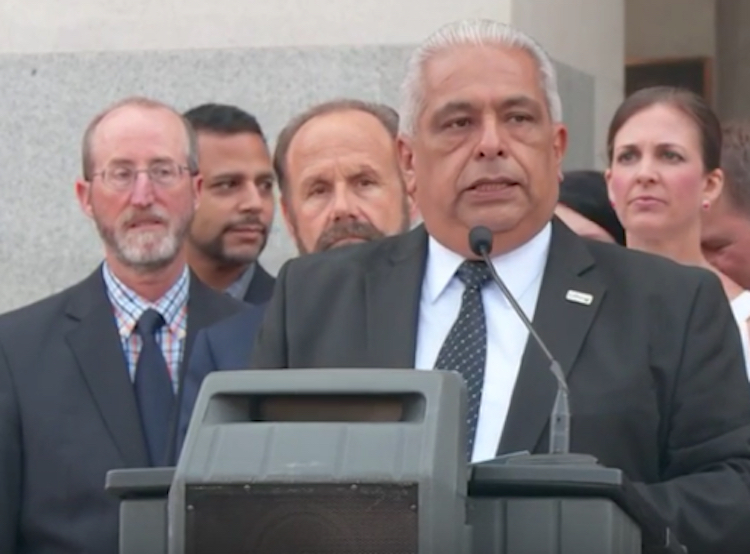
California School Boards Association President Jesús Holguín explains SB 799 at an Aug. eighteen press conference in Sacramento. Behind him are the main authors, Sen. Steve Glazer, D-Orinda (left), and Jerry Loma, D-San Mateo (behind Holguín), forth with co-writer Assemblywoman Kristin OIsen, minority leader in the Assembly.
 Credit: California Senate Democrats
California School Boards Association President Jesús Holguín explains SB 799 at an Aug. 18 press conference in Sacramento. Behind him are the chief authors, Sen. Steve Glazer, D-Orinda (left), and Jerry Hill, D-San Mateo (behind Holguín), along with co-author Assemblywoman Kristin OIsen, minority leader in the Assembly.
A push button in the Legislature to reduce the restrictions on school districts' budget reserves faltered last week after a coalition of school organizations fractured over proposed compromises.
Senate Bill 799 remained stuck in an Assembly committee on Friday, the last day of the session. It will resurface next yr, and negotiations volition continue, said Dennis Meyers, assistant executive director for the California School Boards Association.
At consequence was a disagreement over how far the school organizations should compromise on their beak, which sought a total repeal of the cap on district reserves that legislative leaders and Gov. Jerry Brown imposed, at the urging of the California Teachers Association, as part of the 2022 state upkeep.
The cap would forcefulness districts to spend downwardly money they put aside for economic uncertainties, emergencies and other purposes, similar future computer purchases, whenever the country put money into a new rainy twenty-four hour period fund for K-12 and customs colleges. Although deposits into that fund are predicted to be exceptional – and probably won't be made in the next several years – the California School Boards Association and other schoolhouse management groups, including the Association of California School Administrators, complained that the cap potentially threatens districts' financial stability and their credit ratings, and contradicts the state commitment to local control.
"We likewise loved SB 799, but one of the start rules is don't autumn in love with your bill," said Dennis Meyers, California Schoolhouse Boards Association.
Concluding month, the schoolhouse boards clan-led coalition, which included some children's advancement groups, the League of Women Voters and the California State PTA, proposed an culling to a repeal: SB 799 would exempt from the cap districts with less than 2,501 students, whose finances can be the most volatile, forth with holding revenue enhancement-rich districts, called basic aid districts, which rely solely on local holding taxes to pay their bills. For other districts, the cap on reserves would be raised to 17 pct, near triple the average half-dozen percent that the Legislature imposed. The new limit would be in line with the minimum reserve that a national oversight organization recommended.
Along with the prime authors, Senate Democrats Jerry Hill, D-San Mateo, and freshman Steve Glazer, D-Orinda, 15 Republican and Democratic legislators signed on as co-authors. Just, sensing the bill was however in trouble, CSBA resumed negotiations on its own with the California School Employees Association, the union that represents hourly school employees, such every bit custodians and teachers aides. Those discussions led to a new proposal that would have ready the maximum cap for most districts at 12 percent, midway between the electric current limit and SB 799's 17 percentage, and removed the exemption for many basic assistance districts. It too would have required school boards to give a monthly accounting of money in reserves that districts assigned for specific purposes that didn't count toward the cap under SB 799.
Those proposed changes didn't go over well with members of the coalition, who were presented with them two days earlier the concluding day of the session. The California Associations of School Business Officers, with three,000 members, wrote SB 799'due south sponsors saying the proposed changes "are a step in the incorrect direction and would erode the fiscal condom net to schools." The California State PTA issued an alert to all legislators saying information technology would not back up further amendments or an alternative to SB 799. The Association of California School Administrators didn't officially oppose the proposal because information technology hadn't seen the actual wording, but Executive Director Wes Smith said he also made it clear to legislators that his organization couldn't back up changes to the bill that it hadn't reviewed and approved.
Molly McGee Hewitt, executive director of the schoolhouse business officers organization, said she opposed all three "ill-conceived" changes. She expressed concern that the proposed concessions would make information technology harder to hold the line on passing SB 799 intact.
But Meyers said everyone acknowledges that repeal of the reserves cap "is not actually in the cards," so the goal is to significantly weaken the law. "We also loved SB 799 (every bit originally written)," he said, "just i of the first rules is don't autumn in love with your pecker. Anybody needs to exist open to any changes and so that a bill that tin go signed."
To go more reports like this one, click here to sign up for EdSource'southward no-cost daily email on latest developments in pedagogy.
Source: https://edsource.org/2015/coalition-fighting-cap-on-budget-reserves-stumbles/86965
0 Response to "Coalition fighting cap on budget reserves stumbles"
Enviar um comentário