Report: Economic prosperity relies on boosting immigrant education
Credit: Screenshot of CPS-ASEC data
Immigrant youth without high school diplomas.
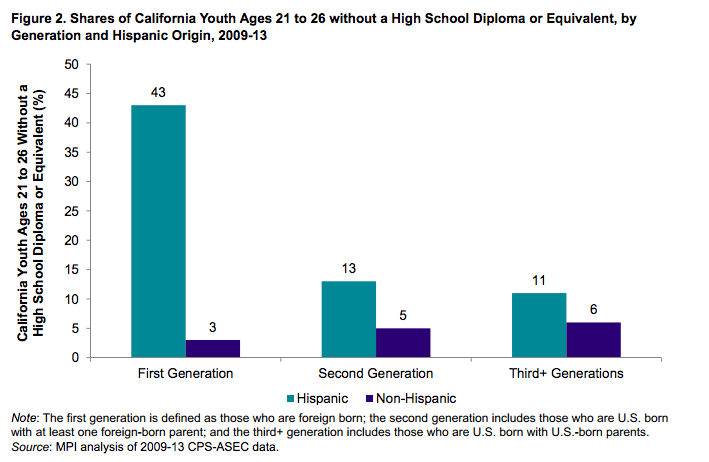 Credit: Screenshot of CPS-ASEC information
Immigrant youth without high school diplomas.
Domicile to one-quarter of the nation's immigrants and a top-destination for incoming refugees, California must significantly improve educational outcomes for immigrant youth if the state – and the nation – are to stay economically competitive, according to a new report.
"California's success in integrating immigrant youth is critical non just to the land but the nation," according to Disquisitional Choices in Post-Recession California, released Wednesday by the Migration Policy Establish, a Washington, D.C.-based recollect tank.
The report calls on California state leaders to accept advantage of recent reforms and a recovering economy to focus more strongly on improving the educational attainment of the growing segment of the land population, many of whom are classified as English learners. California, the written report said, educates more than than one-3rd of English learners in the nation.
"Nosotros can't afford to get out behind such a huge office of the school population," said Christopher Edley, a police force professor and quondam dean at the UC Berkeley law school and quondam co-chair of the U.Due south. Section of Education'south Equity and Excellence Commission. "We have to make a moral commitment that each and every child deserves an constructive instructional strategy."
More than half of those ages sixteen to 26 in California, virtually 3.3 million people, are first- or second-generation immigrants, co-ordinate to the report, notwithstanding immigrants lag behind other groups in bookish achievement.
According to the report:
- Nearly 30 percent of first-generation immigrants ages 21 to 26 in California don't have a high school diploma, compared with thirteen per centum of all youth statewide.
- The iv-year graduation charge per unit of students classified as English learners is 63 percent, compared with a statewide average of eighty percent.
- Latinos – who comprised 51 percent of high school students in 2022 – lag behind other groups in attending college and obtaining higher degrees: 16 percent of the state's 2d-generation Latino students have at least a 2-yr degree, compared to 21 percent nationwide in 2009-13.
California is currently 46th in the nation in the number of adults with high schoolhouse diplomas. The country will have to produce an additional 2.3 million college graduates by 2025 if it is to join the ranks of the meridian 10 states in the number of adults with higher degrees – which are increasingly condign a requirement for available jobs, the report said.
"If current trends persist, the underperformance of first- and second-generation immigrants could imperil the state's future workforce competitiveness," said the report.
Budget cuts during the recession undercut student services, resulting in instructor layoffs, a reduction in higher enrollment, and severely diminished adult education services, which allowed many immigrant students to pursue language classes or receive additional support, the report said.
The recovering economic system and reforms such as the new Local Control Funding Formula position the land to put a stronger focus on the needs of English learners and other immigrants, written report authors said. The funding formula gives schools more than discretion over how they spend their money and gives additional funding to districts with high numbers of low-income students and English language language learners.
"Coming out of a celebrated recession, California'due south teaching systems are at a watershed, with enormous changes underway affecting funding, governance, standards and accountability at all levels," said written report co-writer Sarah Hooker, an MPI policy analyst, in a argument. "The country's responses to the recession undercut its performance in educating immigrant youth; whether this tape improves will remain in doubt unless the needs of these youth are made a more than central focus of reform and accountability efforts."
To get more reports like this one, click here to sign up for EdSource's no-toll daily e-mail on latest developments in education.
Source: https://edsource.org/2014/report-economic-prosperity-relies-on-boosting-immigrant-education/63342
0 Response to "Report: Economic prosperity relies on boosting immigrant education"
Enviar um comentário